Ingredient Swaps
Building a pan sauce that coats when there is no cream

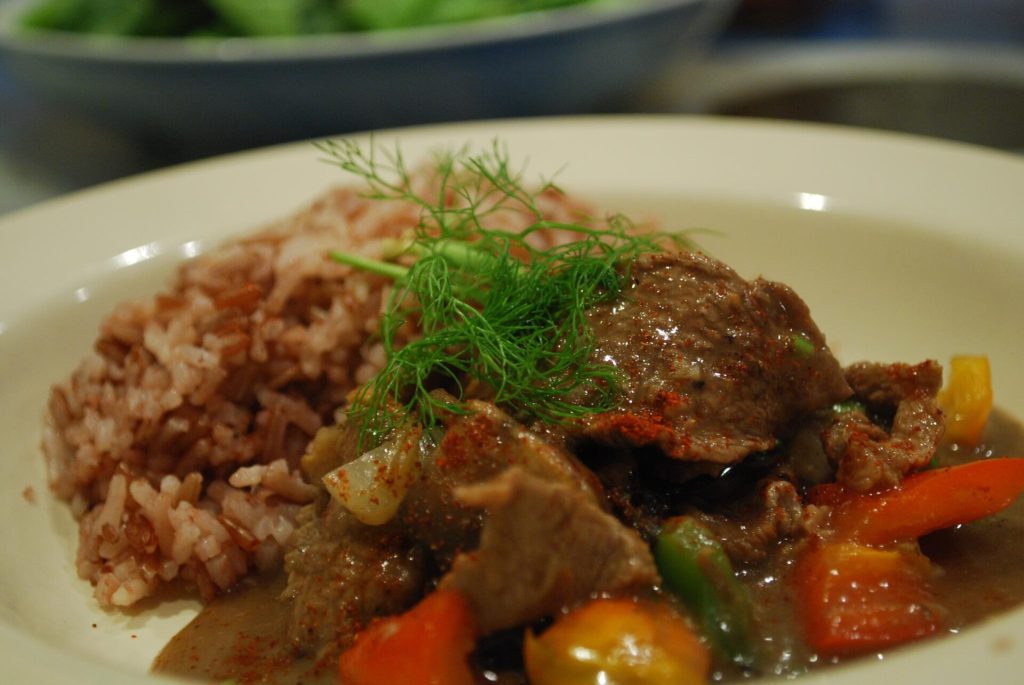
Cream is usually named as the thing that gives a pan sauce its body. Most of what cream does is water boiling off and fat dispersing, and both of those happen without it.
Cream also mutes. It coats the tongue, rounds off acid and turns a sharp reduction into something blander than the pan deserved.
A sauce that coats is a sauce with viscosity, plus fat broken into droplets small enough to stay suspended in it.
Viscosity comes from dissolved protein and gelatin, from starch, or from reduction. The droplets come from fat added at the right temperature.
None of those three requires a dairy product, and two of them are already in the pan after the meat comes out.
What coating means, in the pan and on the plate
Water is thin. A sauce made of stock and pan juices has almost no resistance, so it runs off the meat and pools on the plate.
To coat a spoon, a liquid needs dissolved solids or suspended particles. Reduction adds the first; starch and fat add the second.
The test is a spoon lifted out and turned over. A sauce that coats holds a film with a clean line drawn through it.
A sauce that is merely thick sits in a lump. A sauce that coats spreads and clings, and the difference is fat droplets as much as body.
Fat in water will separate unless something holds it. Protein does that job, which is why mustard and gelatin both help an emulsion.
Cream carries its own protein and fat and arrives already emulsified. That convenience is the whole of its advantage.
Its disadvantage is that the fat is fixed. A sauce built on cream can only get thicker by reduction, and past a point it breaks.
A sauce built on stock and starch can be corrected in either direction until the moment it is served.
A sauce that coats also has to taste of something. Body without flavour reads as slime, which is the usual failure of over-thickened starch.
Reduction, and the gelatin hiding in good stock
Reducing stock concentrates everything in it, including the gelatin that came out of bones and connective tissue.
That gelatin is what makes a reduced stock feel slippery and full rather than simply salty. It is the closest thing to cream in the pan.
A cup of chicken stock reduced to three tablespoons gives a sauce that clings to a chop with no starch at all.
Reduce at a simmer rather than a rolling boil. A hard boil drives the liquid off unevenly and can catch the sugars at the edge.
Skim the fat that rises while it reduces. Fat left in during reduction turns greasy once the sauce is finished.
Taste every couple of minutes near the end. Salt concentrates with everything else, and a stock that was balanced at a cup is sharp at three tablespoons.
Weak, watery stock will not reduce into body. It reduces into salty water, and no amount of whisking changes that.
If the stock is thin, bloom a sheet of gelatin in cold water and stir it in while the stock is warm. One sheet per cup is enough.
Gelatin also makes a sauce that thickens as it cools on the plate, which reads as body even when the sauce is thin in the pan.
A wide pan reduces faster than a deep one, because surface area is what drives evaporation. Use the widest pan that fits the sauce.
Starch, three ways, with the amounts that matter
A roux is equal parts flour and fat, cooked together before the liquid goes in. One tablespoon of each thickens a cup of sauce lightly.
Cook the flour for two minutes before adding stock. Raw flour tastes of paste, and no amount of later simmering hides it completely.
A slurry is flour whisked into cold water, one tablespoon to two, then stirred into the sauce off the heat.
Bring it back to a simmer for two minutes so the starch granules swell and the sauce loses its cloudy look.
Beurre manie is flour worked into soft butter and dropped in as small balls. It thickens and enriches in one movement.
All three dull the flavour slightly, because starch coats the tongue as well as the meat. Use the least that does the job.
If the sauce goes past the thickness you wanted, add stock rather than water. Water thins it and also dilutes the flavour.
Starch thickens most at a simmer and thins again if boiled hard and stirred for a long time, so take the pan off the heat once it looks right.
Mix the slurry in a cup rather than in the pan. Flour dropped into hot liquid clumps, and those lumps do not dissolve afterwards.
Fat, added at the end and not before
Cold butter cubed and swirled in off the heat is the classic finish. One tablespoon at a time, and stop when the sauce turns glossy.
The butter has to be cold and the sauce has to be off the boil. Hot sauce melts the butter faster than it can disperse it, and the fat pools.
Oil alone will not emulsify. It needs a stabiliser, and half a teaspoon of mustard does the job in a quarter cup of sauce.
Mustard also adds acid and a savoury note, which is often what a cream-based sauce was missing in the first place.
A spoon of mayonnaise stirred in off the heat works on the same principle, and it is more stable than butter at low temperatures.
An egg yolk will thicken and enrich half a cup of sauce, but it has to be tempered with hot liquid first and kept below a simmer.
Fat from the pan itself can be enough. Pour off all but a tablespoon of the roasting fat, then build the sauce in what remains.
Add the butter in three additions rather than one. The emulsion forms between them and holds longer once the sauce is on the plate.
Body from things that are not fat
Cooked onion, garlic or squash pureed into a sauce gives it weight and a flavour that belongs to the dish.
Push the sauce through a sieve afterwards if the puree is coarse, or leave it rough for a sauce with texture.
Tomato paste cooked for a minute in the pan adds body, colour and depth at the same time. It is the most useful thing in a tube.
A spoon of the water the vegetables were cooked in brings starch with it, and starch is body.
Reduced stock, gelatin and starch are the three reliable thickeners. Everything else is a variation on one of them.
Acid does not thicken, but it makes a thin sauce taste finished. A few drops of vinegar at the end can make a sauce seem fuller than it is.
Salt does the same thing in a different direction. An under-salted sauce tastes watery no matter how much body it has.
The liquid the meat rested in, poured back into the pan and reduced, is often more useful than anything added from a jar.
Why the sauce breaks, and how to bring it back
A mounted sauce breaks when it boils. The droplets of butter coalesce and float, and the sauce looks separated and greasy.
Too much acid does the same thing by clumping the proteins that were holding the emulsion together.
Cold liquid added to a hot starch sauce breaks it too, because the granules contract before the new liquid can be absorbed.
The repair is the same in each case. Take the pan off the heat and whisk in a teaspoon of cold water or stock.
If that does not work, strain the sauce and start the emulsion again with a fresh teaspoon of mustard and cold butter.
Reheat gently after the repair. A repaired sauce will break a second time at a lower temperature than the first.
A broken sauce still tastes right and looks wrong. That matters only if it is going onto a plate for someone else.
Put the pan back on medium heat now, add a quarter cup of stock and scrape the fond up with a spoon.
Let it reduce to about three tablespoons, take it off the heat, and swirl in a teaspoon of cold butter until it coats the spoon.