Ingredient Swaps
Choosing a fat for sauteing vegetables when the butter is gone

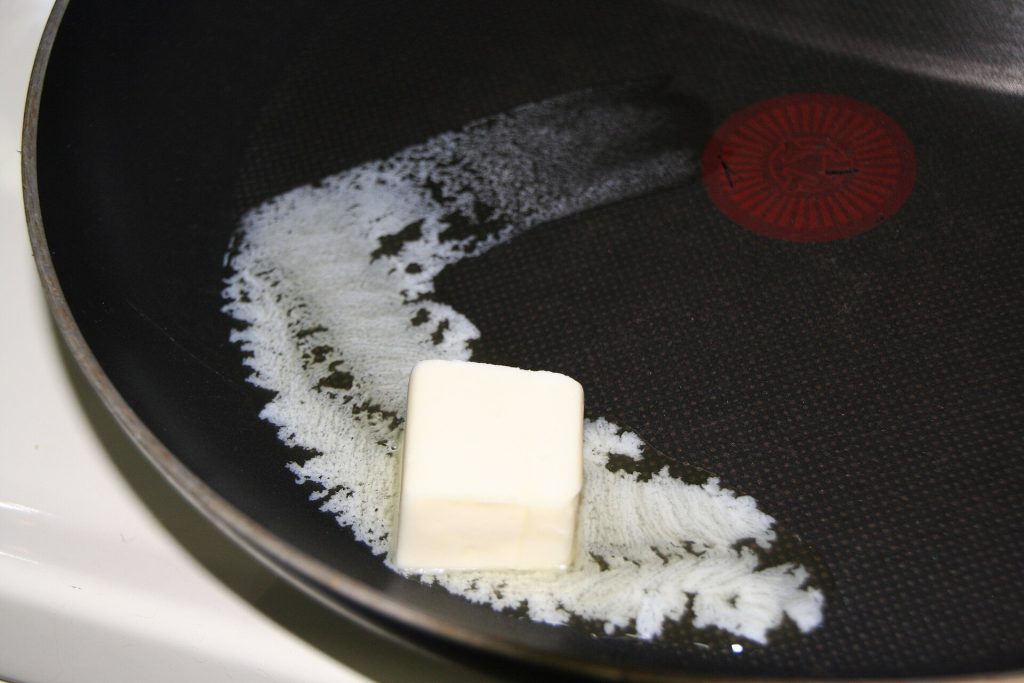
The usual advice is that vegetables should be sauteed in butter because butter tastes better. Butter tastes better in a sauce, and it is one of the worse fats for a hot pan.
Butter is about eighty per cent fat, fifteen per cent water and a few per cent milk solids. The solids brown at around 250F and burn not long after.
What people miss when the butter is gone is not the fat. It is the browned milk solids, which can be produced in a different way in two minutes.
The fat itself has one main job in a pan: it transfers heat between the metal and the vegetable, and it keeps the surface from sticking.
Any fat does that. The differences that matter are smoke point, flavour, and how much the fat costs per tablespoon.
What butter was actually doing
The water in butter steams the vegetables for the first minute. That softens them slightly and delays browning.
The milk solids then brown and give the nutty note that people associate with restaurant vegetables.
Past that point the solids go from brown to black quickly, and the pan turns acrid. Butter is a fat with a narrow usable window.
It also emulsifies with the water in the vegetables, which is why buttered vegetables look glossy rather than oily.
Oil does not emulsify on its own. It sits on the surface, which is why vegetables cooked in oil can look greasy and taste flat.
Clarified butter removes the solids and raises the smoke point, which fixes the burning and loses the flavour at the same time.
Butter also carries salt, and salted butter seasons as it cooks. When the butter is gone that salt has to be added on purpose.
Some of what people notice is the water rather than the fat. Butter steams the vegetables for a minute, and that steam softens the edges.
A fat that is solid at room temperature also coats the mouth differently from one that stays liquid. That is a real part of the difference.
Heat tolerance, and what smoke actually tells you
Refined oils, including ordinary olive oil, sunflower and rapeseed, hold up past 400F without smoking. That is well beyond sauteing temperature.
Extra virgin olive oil smokes earlier, around 375F, and it is still fine for vegetables cooked at medium heat.
Smoke is not the same as ruined. An oil that smokes briefly is not poisonous, but it has started to break down and it will taste of the pan.
Unrefined oils with particles in them burn faster than their rated temperature suggests, because the particles scorch first.
Coconut oil sits in the middle and brings a sweetness that suits squash, sweet potato and corn, and fights with broccoli.
Toasted sesame oil belongs at the end of cooking as a seasoning. It burns at a low temperature and its flavour overwhelms everything else.
Animal fats, lard and beef drippings, hold heat well and bring their own flavour. They suit potatoes, onions and cabbage.
Bacon fat is a seasoning as much as a fat. Use half of it and half a neutral oil, or the vegetables taste of nothing but smoke.
The temperature that matters is the one at the surface of the pan, not the number printed on the dial. A thermometer settles the question in seconds.
Oils differ in how fast they polymerise onto the pan. Refined oils leave a harder film, which is good for non-stick and bad for washing up.
Fat that has been used once and strained keeps most of its heat tolerance. Reusing it more than twice is where the trouble starts.
Flavour: neutral against assertive
A neutral oil lets the vegetable taste of itself. That is the right choice for green beans, peas and anything delicate.
Olive oil adds a slight bitterness that suits greens, cabbage and peppers, and clashes with nothing in those dishes.
The bitterness increases as the oil heats. A dressing made with the same oil tastes milder than a saute made with it.
Nut oils are for finishing. Heated walnut or hazelnut oil turns harsh within a minute and loses the point of using it.
If two fats are in the cupboard, cook in the neutral one and finish with the flavourful one. That gives both heat tolerance and taste.
A teaspoon of a strong fat at the end carries more flavour than two tablespoons used at the start, because none of it is cooked off.
A strong fat used at the start is mostly wasted, since its volatile parts leave with the steam before the vegetables are done.
Vegetables that will be eaten cold take a stronger oil better than vegetables served hot, because cold mutes the flavour of the fat.
Getting the browned note without butter
Milk powder toasted in oil produces the same browned-solids flavour that butter gives, without the water and without the burning.
Heat two tablespoons of neutral oil in the pan, add a tablespoon of milk powder, and stir for a minute until it smells nutty and turns light brown.
Then add the vegetables. The powder coats them and browns further, and the effect is close enough that people ask what is in it.
Keep the heat at medium for this. Milk powder scorches at the temperature where butter would have burned anyway.
Toasted nuts and fried shallots do the same job from a different direction, and both keep for a week in a jar.
A spoon of browned fat from a roast, poured off and kept in the fridge, gives a similar note with no work at all.
Milk powder keeps for months in a sealed jar, and it browns in oil at a temperature where butter would already be black.
The powder foams and then settles. That is the water leaving it, and the whole process takes about thirty seconds.
When water is the better medium
Some vegetables do not need fat to cook well. Greens, asparagus and carrots will soften in two tablespoons of water in a covered pan.
Water transfers heat faster than oil and it cannot burn. The vegetables keep their colour and their shape.
Uncover the pan at the end and let the water boil off, then add a teaspoon of oil to gloss them.
This works badly for mushrooms, which release their own water and need dry heat to brown, and badly for potatoes, which need fat for crust.
It works well for anything that will be dressed afterwards, because the dressing supplies the fat that the cooking did not.
Water also dissolves some of the vegetable’s own sugars, which is why the liquid left in the pan tastes sweet.
Do not pour that liquid away. Reduce it and add it back, or use it as the base of a dressing for the same vegetables.
Steaming first and finishing in oil gives two textures at once: soft through the middle, glazed on the outside.
Quantity, temperature and crowding
One to two tablespoons of fat for a twelve-inch pan is the working range. More than that and the vegetables fry rather than saute.
Vegetables absorb oil as they cook, so a pan that looked wet at the start looks dry after two minutes. Add more around the edge, not on top.
Heat the pan before the fat and the fat before the vegetables. Oil that shimmers is ready, and oil that smokes has gone too far.
The vegetables should sizzle when they touch the pan. If they do not, the pan is not hot enough and they will steam instead.
Crowding drops the pan temperature faster than any flame can recover it. Cook in two batches rather than one deep pile.
Salt draws water to the surface, and water stops browning. Salt at the end for crisp edges, at the start for soft vegetables.
A crowded pan will not recover its heat until enough of the vegetables have released their water and cooked off.
Thin slices brown faster than thick ones and need more fat per piece, because there is more surface exposed to the metal.
Wipe the pan between batches rather than adding oil to a pan full of burnt bits and loose salt.
Keep the finished batch warm on a tray in a low oven rather than piling it back into the pan with the next one.
Put two tablespoons of neutral oil in a cold pan now, add a tablespoon of milk powder, and warm it over medium heat.
Stir until it smells of toasted nuts, then cook the vegetables in it and taste the difference against your usual oil.