Heat and Timing
Carryover cooking and the rest that finishes the meat

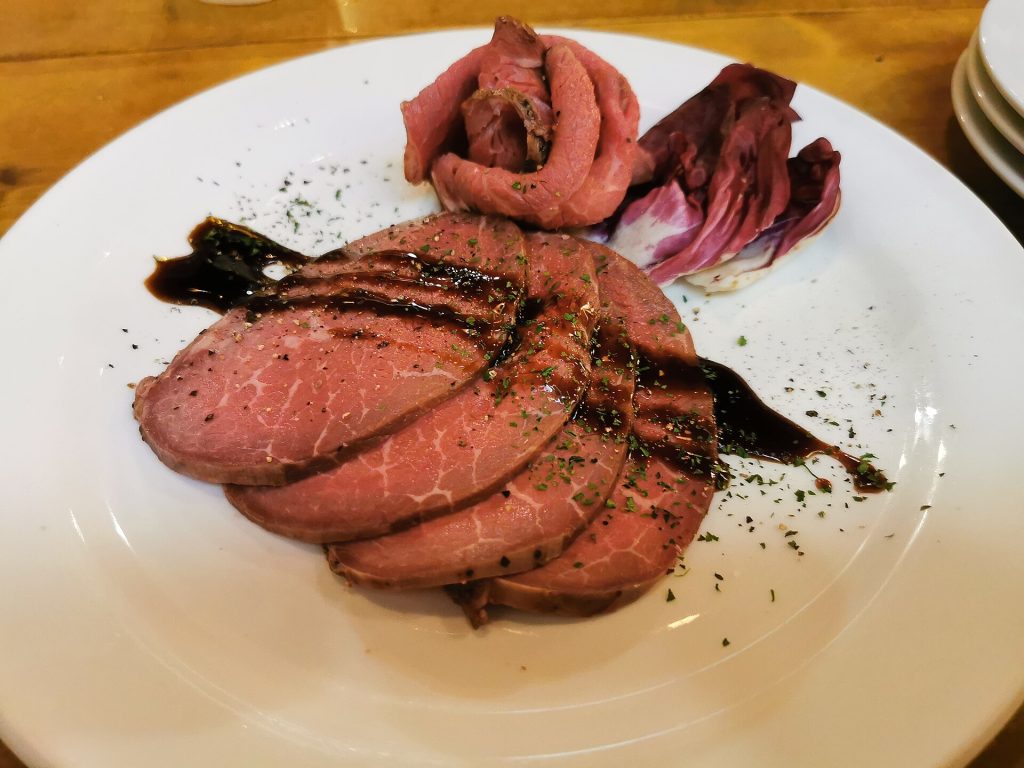
The usual explanation for resting meat is that it keeps the juices inside. That is the smaller half of the story, and it is not the reason a cook pulls a roast out of the oven early.
The larger half is temperature. A piece of meat is never the same temperature from edge to center when it leaves the heat.
The surface may be at 300F. The middle is at whatever the thermometer said. Heat keeps flowing from the hot outside toward the cool inside whether or not the pan is still under it.
That flow is carryover, and it continues until the gradient is gone. On a large roast that takes twenty minutes and adds fifteen degrees.
Why the center keeps climbing off the heat
Meat is mostly water held inside muscle fibers, and water conducts heat slowly. That slowness is the whole mechanism.
When you sear, the outer few millimeters climb far above the center. The gap can be 150F in a thick roast and much less in a thin steak.
Heat always moves down that gap. Take the pan away and the gap still exists, so heat keeps travelling inward until the two ends meet somewhere near the middle.
Nothing about the stove is required for this. A roast on a board is still cooking. A steak on a plate is still cooking, only more slowly.
The rate depends on how steep the gap is. A hard sear in a hot pan builds a steeper gap than a gentle one, so it carries over further.
This is why a thin cut is easy and a thick one is not. A one inch steak has little distance to cover, and the center catches up in three or four minutes.
A four pound roast has four inches to cover and a much hotter outside. It will keep climbing for a quarter of an hour.
Shape matters as much as weight. A flat roast climbs faster through its thickness than a tied cylinder of the same weight, because the heat has less distance to travel.
A tapered end or a thin tail is already ahead of the rest. Fold it under, or accept that the tip will finish well past the center.
A roast taken from the oven into a cool room cools at the surface while the center climbs. The two temperatures move toward each other and settle somewhere between the two starting values.
The four things that decide how far it climbs
The first is thickness. Carryover scales roughly with the square of the distance, so doubling the thickness quadruples the rise.
The second is surface temperature. A roast taken from a 500F oven carries more heat in its crust than one from a 325F oven, and it overshoots further.
The third is the resting surface, which either drains heat away or holds it. That changes the curve more than most cooks expect.
The fourth is time. Carryover is fast at the start and flattens out, so most of the rise happens in the first third of the rest.
Put together, a steak gains five to ten degrees, a chicken breast five to eight, a pork loin about ten, and a large roast fifteen to twenty.
Those are the numbers to subtract when you decide where to pull. Not a guess, a subtraction.
Ovens also cycle on and off, so the reading at the moment you open the door can sit a degree or two below the peak. That is another reason to leave margin.
Bone shifts the reading. A chop cooked on the bone conducts heat along it, so the meat beside the bone can read several degrees ahead of the rest of the cut.
Where you rest it changes the result
Resting on a cold plate is the common mistake. The plate pulls heat out from below while the center is still climbing, so the outside goes cool before the middle is done.
A wooden board is a poor conductor and takes very little heat. The meat keeps its surface temperature and the crust stays crisp for longer.
A wire rack over a tray is the best of both. Air reaches the underside, the crust does not sit in its own steam, and the juice collects below instead of under the meat.
If the meat is going back into a hot oven or under a broiler later, rest it on the rack and skip the foil entirely.
The reverse holds for a thin cut that cooled too fast. A warm plate and thirty seconds of loose foil bring the surface back without pushing the center higher.
A grooved board catches what runs off, and that juice is the start of a pan sauce rather than waste. Pour it into the roasting tin and set the tin on a low burner.
What the juice is doing while the meat sits
Heat makes muscle fibers contract, and contracting fibers push water toward the center. That is why the middle of a just cooked steak looks wetter than the edges.
Sliced immediately, the pressure is still high and water leaves the cut face in a rush. That is the puddle on the board.
As the meat cools, the fibers relax and the pressure equalizes. Water spreads back through the piece instead of being pushed out of it.
The difference is real, but smaller than the temperature difference. A steak rested for five minutes loses less juice than one cut at once, and it also has a center five degrees cooler than the number you wanted.
Both effects matter. The temperature is the one you can measure, so it is the one to plan around.
Longer is not automatically better. Past about fifteen minutes a steak begins to lose its heat to the room, and a thin cut will be lukewarm at the center.
Match the rest to the size. Three to five minutes for a steak, eight to ten for a chicken, fifteen to twenty for a roast.
Slicing against the grain is a separate gain. Short fibers release less at the cut face, which is why the same roast slices cleaner when the knife crosses the muscle rather than running along it.
Foil, tents and the crust you trade away
A tight foil tent traps steam, and steam softens the crust the sear just built. Fifteen minutes under foil turns a crisp surface into a damp one.
The tent does slow heat loss. That is its only advantage, and it matters most for a large roast in a cold kitchen.
If you use one, leave it loose at one side so vapor can escape. The foil should be a shelter rather than a lid.
A better tool is an oven turned off with the door left ajar. Ambient warmth replaces the foil without trapping moisture against the meat.
For poultry the skin problem is separate. Skin stays crisp if air can reach it, so rest the bird on a rack and leave it uncovered.
A bird rested breast up and open dries slightly as it sits, and that surface drying is what keeps the skin crisp. Foil removes it in a few minutes.
For a roast with a deep crust, uncovered on a board is enough. That crust is a layer of insulation in itself.
The temperature to pull at, and what to do in the next ten minutes
Subtract the expected carryover from the target and pull there. Medium rare beef at 130F means pulling at 120F to 123F.
Pork at 145F means pulling near 137F. Chicken breast at 160F means pulling at 155F and letting the rest finish it.
Use a probe in the thickest part, away from bone and fat. Bone conducts heat differently and will read high or low depending on the cut.
The touch test runs alongside the probe. A surface with a little spring and give is close. A tight, firm surface is already past.
Write down what you pulled at and what the meat read after the rest. Two or three repetitions and your own oven tells you its own offset.
Tonight, take a steak out of the pan at 120F, put it on a board with no foil, and set a timer for five minutes.
Then cut it and look at the band of grey under the crust. A thin, even band means the pull temperature was right.
A deep band means the meat was still climbing when it came off. Pull earlier next time, and let the rest do the last part of the cooking.
If the band is thin but the center is underdone, the oven ran cool and the cut needs a lower pull point, not a longer rest.