Heat and Timing
Searing without steaming when a pan is crowded

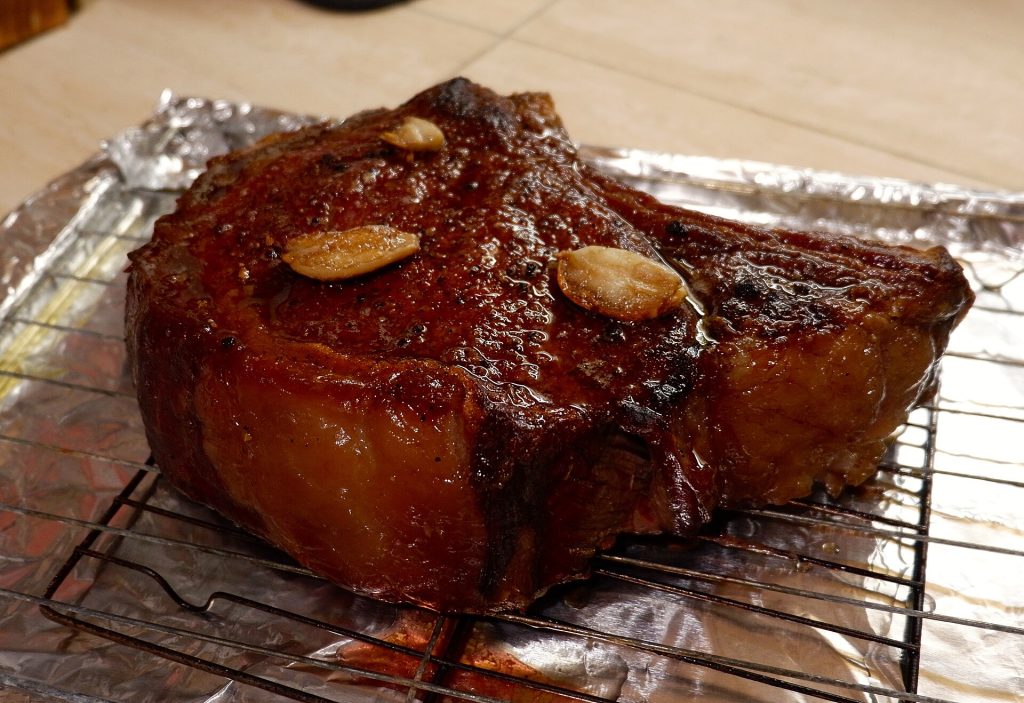
Most recipes deal with crowding in a single line: sear in batches if necessary. They rarely say how many batches, and almost never say what the pan is doing while the rule is ignored.
The usual fixes, a bigger pan or a hotter burner, do not solve it. Once the pan floor is more than half covered, the food is cooking in steam, and no amount of heat changes that.
The limit is not temperature. The limit is how fast water can leave the pan.
What crowding does to the surface of the food
Meat and vegetables both release water as they heat. In a dry pan that water flashes to vapor and leaves.
In a crowded pan it cannot leave fast enough. It sits in the gaps, fills the space above the food, and condenses on anything cooler than itself.
The result is a surface held near 212F, the temperature of boiling water. Browning needs 300F or more.
So the food goes grey before it goes brown. The surface looks wet and slightly dull, and it makes almost no sound.
Vegetables show it more plainly than meat. Mushrooms go from wet to grey to brown, and in a crowded pan they stop at grey and sit there, shrinking in their own liquid.
Sliced zucchini behaves the same way. Piled in a skillet it steams into limp half moons. Spread on a tray it browns in patches and keeps some bite.
The sound is the giveaway. A piece of meat that is searing roars and cracks. A crowded pan whispers, then goes quiet.
You can also see it in the pan. Fond, the browned layer that should stick to the metal, never forms. Instead there is a pale liquid that slowly darkens into a thin broth.
That broth is the tell. If there is liquid in the pan after two minutes, the pan is too full or not hot enough, and usually both.
The half pan rule
Food should cover no more than half the pan floor, in one layer, with gaps between the pieces.
A twelve inch skillet has about 113 square inches of floor. Half of that is 56 square inches, which is two steaks of moderate size and not three.
Gaps matter as much as total area. Two pieces touching along an edge share a wet seam that never browns, and the seam is visible on the plate.
The gaps are the chimneys. Vapor rises through them and away, and the dry metal between the pieces keeps the pan temperature up.
For vegetables the rule is stricter, because a sliced onion or a mushroom releases far more water per square inch than a steak does.
A single layer with visible metal between the pieces is the only arrangement that browns. Anything deeper is a steam tray with a hot bottom.
The rule has a second part: nothing stacked and nothing leaning. A piece propped against another keeps a wet face where they touch, and that face stays pale.
Weight per area is the measure to remember. A pound of meat spread over twelve inches is comfortable. The same pound over eight inches is a steam bath.
Why a hotter burner cannot outrun water
Boiling water away takes a large amount of energy. Turning a pound of water into vapor absorbs about 970 heat units, enough to raise that same pound from room temperature to boiling six times over.
A domestic burner puts out roughly 10,000 heat units an hour at full power, and only part of that reaches the pan. Boiling off a pound of water takes several minutes of the entire output.
So the water wins. A burner turned to maximum raises the pan temperature, but the surface of the food cannot pass 212F while water is still evaporating from it.
Extra heat goes into the water, not into browning. That is why a crowded pan on high heat produces more steam, not more color.
This is also why the pan cools when food goes in and stays cool. The stored heat is spent on evaporation, and the pan sits at the boiling point until the water is gone.
More food means more water, and more water takes longer to clear. The relationship is not proportional, which is why a double batch can take well over twice as long to brown.
A lid makes the outcome certain. Closed, the pan traps every bit of vapor and the food cooks at the boiling point no matter what the dial says.
Steam also carries heat away from the pan itself, which is why a crowded pan feels cooler at the rim than an empty one on the same flame.
Pan size against burner size
A pan wider than the burner is not fully heated. The outer ring sits over air, and food placed there cooks by conduction from the center rather than by direct heat.
On a typical home range the burner is eight or nine inches across. A twelve inch skillet therefore has a hot middle and a warm rim, and the difference is large.
Put that pan on the largest ring and the hot zone grows but does not reach the edge. Use a pan closer to the burner size, or accept that the rim is for keeping food warm.
A wide pan also loses more heat from its exposed surface. Its greater area helps evaporation, but only over the part that is actually hot.
A thin pan widens the problem. Its hot zone is small and its edges lose heat quickly, so the floor that works is smaller than the floor you measured.
A thick base spreads heat sideways and can hold a sear near the rim, which a thin pan cannot. Match the mass of the pan to the size of the batch.
The practical choice is a heavy pan that matches the burner, used twice, rather than a wide pan used once. Two batches in a hot pan beat one batch in a lukewarm one.
Deep pans, piles and the tray that fixes it
A deep pan makes crowding worse because the walls hold the vapor in. A saute pan with three inch sides traps steam in a way a shallow skillet does not.
A pile is the extreme case. The bottom layer sits in liquid pressed out of the layers above, and the top layer never touches metal at all.
If the pile is unavoidable, spread it on a tray instead. A sheet pan with low sides gives every piece contact with metal and open air above it.
Give the pieces space on the tray and put it in a hot oven rather than under a broiler. The air does the work, and the tray’s large floor area keeps the vapor moving away.
A rack inside the tray helps further for anything wet. The food sits above the liquid that runs off rather than in it.
Flat cooking surfaces exist for the same reason. A wide griddle gives every piece its own patch of hot metal and open air above it, which is why it beats a deep pan for a large batch.
For a lot of vegetables, the oven is the better tool. Air moves across the surface on all sides, and the tray can be as wide as the shelf.
The test, and what to do in the next ten minutes
Heat a dry pan, add fat, and lay in one piece of meat. Listen for two seconds.
A roar means the surface is dry and the pan is hot. A hiss that fades means water is winning and the pan is overloaded or underheated.
If it hisses, take the food out, wipe the pan, bring it back up, and put in half as much. The second attempt takes four minutes and produces the crust the first one could not.
Then leave the pieces alone until they release. Crowding and early moving are separate faults, and a pan that is too full will tempt you into both.
Before the next batch, pour off the liquid, wipe the pan with a cloth, and add fresh fat. A wet pan cannot sear anything.
The working order for a big batch is short. Sear a third of it, move that third to a warm plate, wipe the pan, and repeat.
Each batch leaves fond behind, and the fond stays in the pan when the meat comes out. By the last batch the pan is dark with it and the crust forms faster.
Those later batches take less time, once the pan has recovered. A pan is a store of heat with a memory, not a switch.