Prep and Storage
Cooling food fast, and why the fridge is slow at it

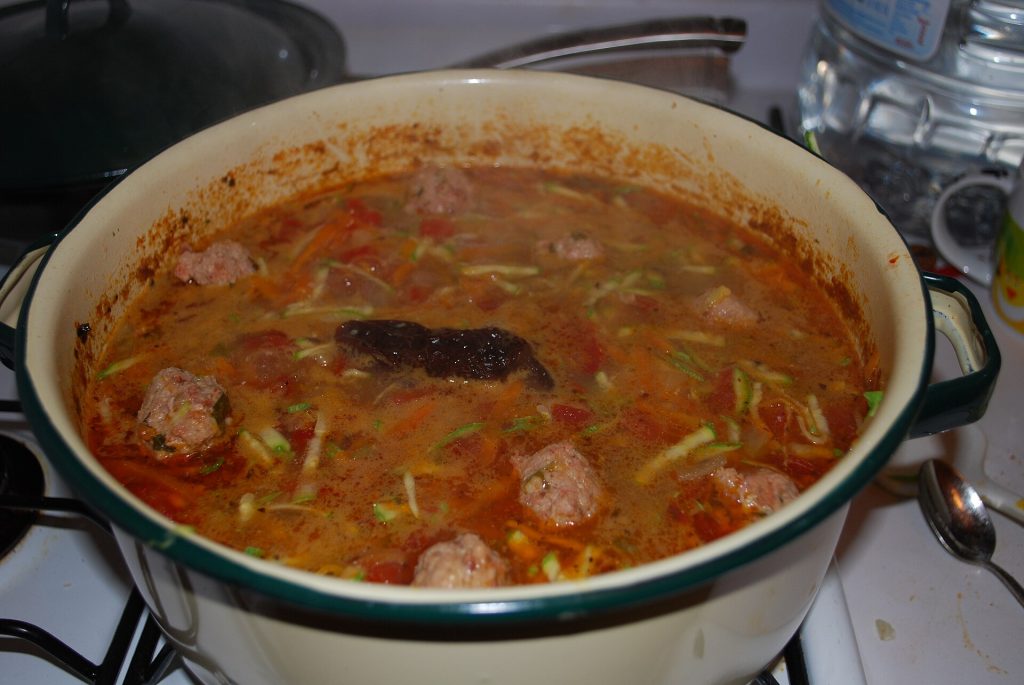
The instruction to let a pot sit on the counter until it stops steaming before it goes into the fridge is one of the slowest pieces of advice in a home kitchen. A covered pot of stew can stand there for three hours and still be warm at the center.
The fridge is not a cold room that chills food on contact. It is a box that removes heat through air, and air carries heat about twenty five times less effectively than water does.
So a hot pot does two bad things at once. It cools slowly, and it spends the fridge’s capacity on itself while everything around it drifts upward in temperature.
Cooling faster is a question of shape and surface rather than equipment. Two changes take a four liter pot from three hours to under one.
What a hot pot does inside the fridge
A fridge removes heat at the evaporator and circulates cold air with a fan. The air has to reach the food, take heat from the surface, and come back cold.
Around a tall covered pot, that circulation stalls. The pot warms the air beside it, the air rises and sits against the ceiling, and a pocket of warmth forms that the fan does not clear.
The thermostat sits somewhere in that box and reads the average. It runs the compressor hard, the back wall ices up, and the pot is still at thirty degrees two hours later.
Meanwhile the milk and the cut fruit on the next shelf are passing through the range where spoilage organisms work fastest. A fridge full of warm food is a fridge that is not doing its job.
None of this argues for leaving food out. It argues for taking the heat out of the food before the fridge has to, and for doing that in water rather than air.
Surface area beats volume every time
Heat leaves food through its surface, so the depth of the food sets the distance the heat has to travel. Halve the depth and each bit of food is twice as close to a cold surface.
The gain is larger than the halving suggests. Splitting one deep pot into four shallow ones roughly doubles the surface and halves the distance, so the same food cools in about a quarter of the time.
Depth of about five centimeters is the practical target for a home container. Past eight or ten, the middle lags far behind the edges and the average reading lies to you.
A wide roasting tin or a rimmed tray is the fastest vessel most kitchens own, and it is already out. Food spread to a finger’s depth in a tray will cool while you eat dinner.
Metal helps. Aluminum and steel pass heat to the surrounding air far better than thick plastic, which insulates the food from the cold it is sitting in.
The shape of the food matters as much as the container. A whole roast cools slower than the same roast cut into two, and a dense mash cools slower than the same volume of soup.
A pot taller than it is wide is the worst shape a kitchen owns for this job. Stock in a deep stockpot has the least surface per liter of anything you are likely to cook.
The sink of cold water
Water is the strongest cooling tool in a kitchen and it costs nothing. A pot set into a sink of cold water sheds heat through its base and sides at a rate air cannot approach.
Ice makes it faster still, because the difference in temperature between the food and the water is what drives the transfer. A tray of ice cubes and two liters of tap water is enough for most pots.
Set the pot in the sink, run cold water to about a third of the pot’s height, and add ice. Water above the rim line is wasted and makes the pot unstable.
Stir the food, then stir the water, then stir the food again. Both sides of the metal need to keep moving, because a still layer of water next to a still layer of stew insulates both.
A four liter pot of stew at ninety degrees reaches room temperature in about half an hour this way, against three hours on the counter. The ice melts, the water warms, and you add more ice once.
For a container rather than a pot, the same trick works in the sink or in a basin. Two frozen bottles of water laid against the sides of a box do a surprising amount of the work.
Splitting the pot instead of stirring it
Stirring a deep pot feels productive and does very little. It moves warm food from the middle to the edge, but the edge is only as cold as the room, so the heat has nowhere to go.
Dividing the food does what stirring cannot. Four shallow containers have eight times the surface of one deep pot for the same volume, and each one can be handled separately.
Spread the food between containers while it is still hot, and do not fill any of them past two thirds. A full container slops, and the space above the food is where the steam goes.
Leave the lids off and leave the containers apart. Nesting one warm box against another puts insulation on the outside of both.
If the food is a sauce or a stew, a tray is better than a box. Pour it to a depth of three centimeters, leave it on a cool surface, and it will be ready to box before the plates are washed.
Rice and grains are the awkward case. Packed while warm into a deep box they hold heat for hours, so spread them on a tray first and box them once they are cold.
Lids, stacking and the clock on the counter
A lid on hot food traps steam, and steam is water that has already taken heat from the food. Letting it escape is part of cooling, not a loss.
So the lid goes on late. Twenty to thirty minutes uncovered in a shallow container does more than an hour of open-pot standing, and the surface does not dry because the food is still warm.
The counter clock is worth watching. Two hours from the moment the heat comes off is a reasonable outer limit for anything that will be eaten later, and less if the room is hot.
Do not put a warm container against the back wall of the fridge or in the door. The back wall is the coldest surface and will freeze what touches it, and the door is the warmest place in the box.
Leave a hand’s width between containers on the shelf. Cold air has to get into the gaps, and a shelf packed tight cools as one solid block.
Stacking is the last mistake. Two warm boxes stacked have a warm interface that neither can cool through, so they stay warm together for hours.
Judging when it is cool enough to close
A thermometer is the honest answer. A probe in the center of the deepest container should read below about ten degrees before the lid goes on, and the fridge holds food near four.
Without a probe, use the outside of the container. When the base and sides feel cool to a flat hand, and no steam rises when you lean over it, the food is close enough.
Another check is condensation. A lid put on food that is still warm fogs within a minute, and that fog is water the food gave up. Wait until the lid stays clear.
Once closed, the container goes on a middle shelf where air moves, not on the floor of the box and not against the wall. Label the lid with the day you plan to eat it.
Then leave it alone. Opening the door to check on it lets the cold air out and adds minutes to the job the fridge is already doing.
Tonight, when the pot comes off the heat, put it in the sink, run cold water to a third of its height, add ice, and stir both the food and the water for ten minutes.
Then spread what is left into two shallow containers, leave them uncovered on the counter until the sides feel cool, and put them in the fridge with a gap between them.