Weeknight Dinners
How to stir-fry in a flat skillet without a wok

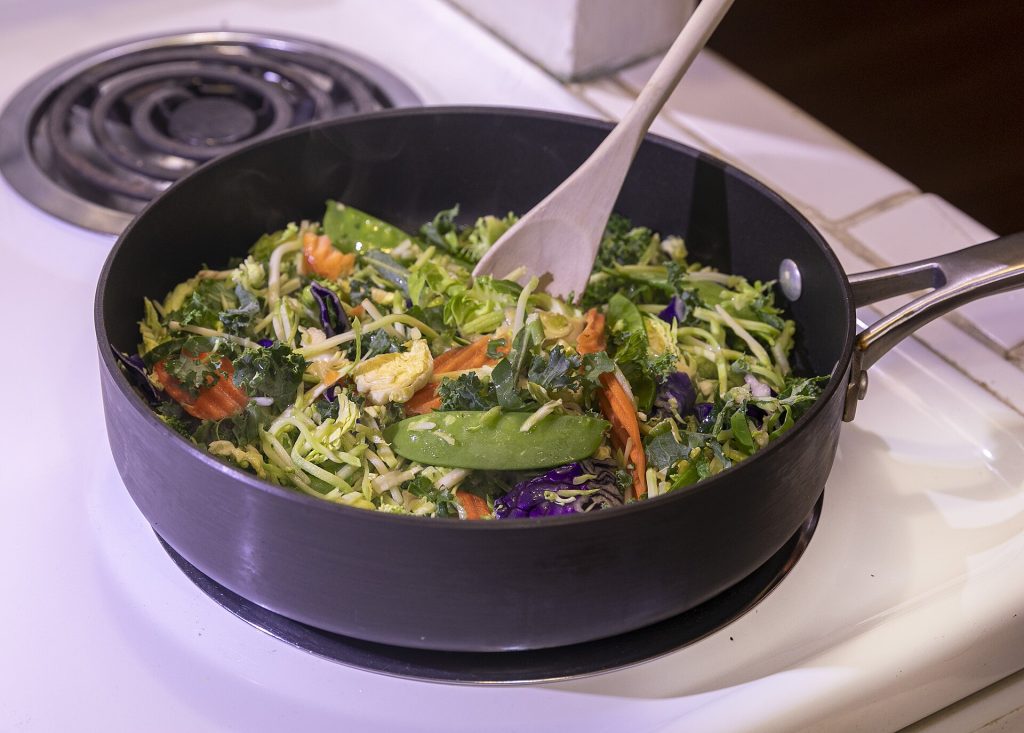
The standard answer to stir-frying at home is to buy a wok. That answer treats the pan as the problem. The pan is only part of it, and the larger part is heat loss.
A wok works because of its shape, not its material. A wide bowl with a small flat base concentrates the burner under a small area and lets the sides sit away from the flame.
Food thrown up the sides leaves the hot zone. That is how a wok keeps vegetables crisp while cooking them fast: the food cycles in and out of contact instead of sitting in it.
A flat skillet cannot do that. Everything stays in contact, which means everything keeps drawing heat out of the metal at once.
You can still get a stir-fry from a skillet. You have to replace what the shape was giving you: a small hot zone, constant movement, and short contact times.
What the wok shape does that a skillet cannot
Put a pound of cold vegetables in a hot wok and the pan recovers its temperature in seconds. The same pound in a skillet drops the surface temperature by a hundred degrees or more.
A skillet holds the whole batch flat against the base. The base is the only source of heat, and it is now covered by a layer of cold, wet food.
Recovery is the number that matters. A pan that takes ninety seconds to come back to temperature will steam its contents for those ninety seconds.
You cannot fix this with a bigger flame. The burner has a fixed output, and a thin pan will simply develop a hot ring in the centre and a cool rim.
What you can do is reduce the load. Half the food in the pan means half the heat drawn out, and recovery time falls with it.
A flat pan holds heat if you stop filling it
Choose the widest heavy pan you own. Width gives you surface area, and mass gives you stored heat that the food cannot drain in a hurry.
Preheat for three full minutes on medium high before anything goes in. A pan that is only warm at the start will be cold by the time the second batch arrives.
Test with a drop of water. It should skitter across the surface and evaporate within a second or two. If it sits and bubbles, the pan is not ready.
Add the oil after the pan is hot, not before. Oil added to a cold pan has time to spread and break down before the food ever touches it.
Keep the pan moving. Not the theatrical toss, just a firm push and pull with a spatula every fifteen seconds, so the food changes position on the hot metal.
Leave gaps. A single layer with visible pan between the pieces is the target. If you cannot see metal, the batch is too big.
Cook the components separately and combine at the end. This is the single change that does most of the work, and it costs one extra minute of washing up.
Cut everything before the pan is hot
Stir-frying is a sequence measured in seconds, and there is no time to chop between steps. Everything must be cut, dried and within arm’s reach before the burner goes on.
Cut to a uniform thickness, about a quarter inch for most vegetables. Uniform thickness matters more than uniform shape, because thickness is what sets cooking time.
Slice dense vegetables thin and cut watery ones thick. A zucchini loses most of its volume in the pan, so a thick slice holds structure where a thin one collapses.
Dry everything with a towel after washing. Surface water is the main reason a home stir-fry turns into a braise.
Group the ingredients by cooking time on the board, not by type. The aromatics sit together, the dense vegetables sit together, the leaves sit alone.
Have the sauce mixed in a bowl before you start. Soy, a splash of vinegar, a teaspoon of sugar and a teaspoon of cornstarch, stirred until no lumps remain.
Grate or chop the garlic and ginger last, and keep them in a separate pile. They burn in under a minute and they will be added at the very end.
Why the vegetables release water and how to stop it
Vegetables are mostly water held inside cell walls. Heat breaks the walls and the water comes out. The faster the outside of the vegetable cooks, the less water escapes.
Salt draws water out by osmosis. Salting vegetables at the start of a stir-fry pulls moisture to the surface before the pan has had a chance to seal it.
Salt at the end instead, once the vegetables are out of the pan or nearly done. The seasoning still lands, and the water stays inside until the cooking is finished.
A very thin dusting of cornstarch on sliced protein helps in a different way. It dries the surface and gives it a starch layer that browns quickly and holds moisture in.
Use a teaspoon for a pound of protein, tossed through until the slices look dusty rather than coated. More than that turns the sauce gluey.
Mushrooms are the exception to drying. They release water on purpose, and they need to be cooked in a dry hot pan, undisturbed, until that water has evaporated and they start to squeak.
If liquid pools in the pan anyway, stop adding food and let it boil off before you continue. Adding more ingredients to a wet pan only makes more liquid.
Sauce at the end, and mixed before the pan is hot
A sauce built in the pan while the food waits will be either raw or broken. Mix it in a bowl first, so the only job left in the pan is thickening it.
The base is three parts soy to one part vinegar, with a little sugar to round the salt and a little water to give it volume. That ratio is a starting point, not a rule.
Cornstarch needs cold liquid and a minute at a simmer to thicken. Add it to the bowl with the cold water, not to the hot pan, or it will seize into lumps.
Pour the sauce in only when the pan is hot and the food is nearly done. Push the food to one side, let the sauce bubble in the clear metal for twenty seconds, then fold everything together.
That twenty seconds is where the sauce reduces and coats. If you pour it over a full pan of food, it will cool too fast to thicken and you will get a puddle at the bottom.
If the sauce looks thin after a minute, raise the heat and keep the food moving. If it looks thick, add a spoonful of water, not more oil.
Take the pan off the heat before the final toss. Residual heat is enough to finish the sauce and it stops the starch from breaking down.
Sesame oil, if you use it, goes in off the heat. It is a finishing oil, and heating it turns the aroma flat and slightly bitter.
The order: protein out, aromatics in, everything back
Brown the protein first, in one layer, and take it out while it is still slightly underdone. It will finish in the last toss, and it will not dry out waiting.
Put the protein on a plate, not back in the bowl it came from. The bowl has raw juices on the walls, and the plate does not.
Cook the dense vegetables next, in the same pan, without wiping it. The browned film left by the protein is flavor, and the vegetables will lift it as they cook.
When the dense vegetables are nearly done, push them to the edge and add the aromatics to the clear centre. Twenty seconds for garlic, thirty for ginger.
Add the leaves last, in handfuls, and fold rather than stir. They need thirty seconds to wilt and no more, or they will give up their water and gray off.
Return the protein and any juice on the plate, pour in the sauce, and toss for the last thirty seconds. Everything meets the heat once, at the end.
Serve immediately, on warm plates if you have them. A stir-fry continues cooking in its own steam, and a cool plate speeds that up.
Before you cook, put the largest pan you own on the burner, set the heat to medium high, and lay out three piles: dense vegetables, aromatics, greens. That is the whole setup.