Weeknight Dinners
Shakshuka as a dinner plate rather than a brunch dish

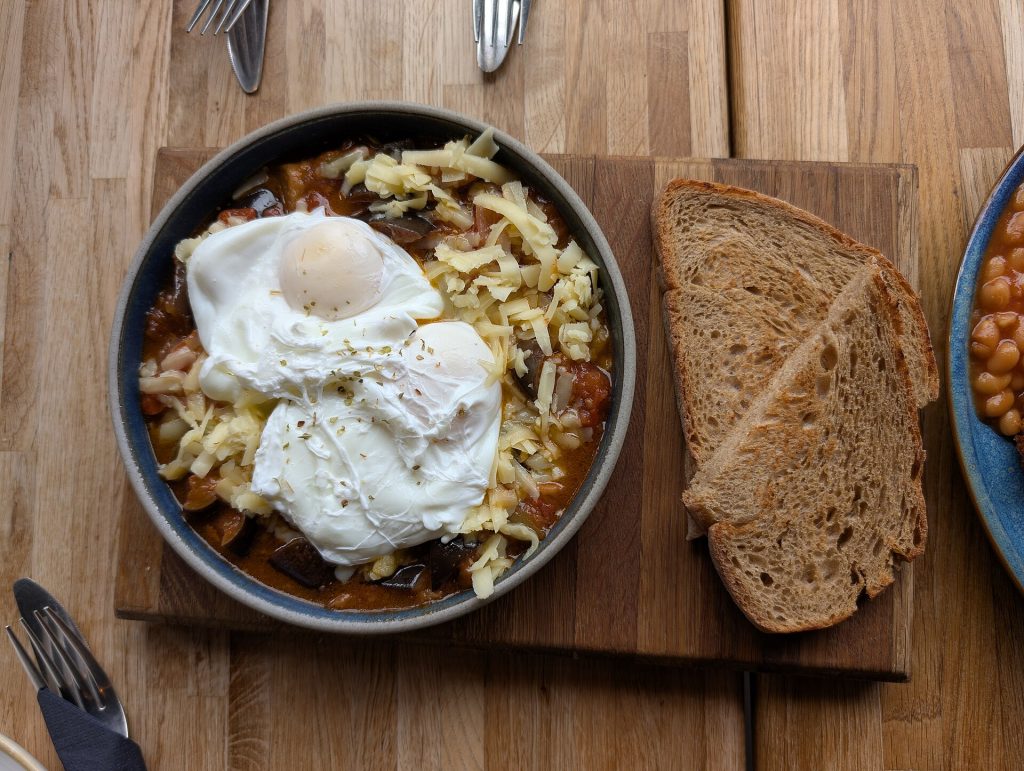
Shakshuka became a brunch dish because it looks good in a shallow pan and it divides easily. As a dinner it is underfed, and the fault is not in the eggs.
The brunch version is a thin tomato sauce with eggs poached in it, served with bread on the side. That is a starter, or a breakfast, and it leaves people looking for something else an hour later.
For dinner the sauce has to be cooked down until it holds a line, the eggs have to be treated as the protein rather than the garnish, and there has to be something underneath.
Those three changes are structural. They do not require more ingredients, and they do not add much time.
The version below serves three as a main course, in one pan, with eggs set at the table rather than in the kitchen.
The brunch version is thin
A can of tomatoes holds a lot of water, and a sauce made from it in ten minutes is closer to a soup than to a stew base.
Thin sauce does two things wrong. It slides off the egg instead of coating it, and it makes the dish wet on the plate, which reads as unfinished.
The fix is reduction. Cook the tomatoes down until a spoon dragged across the pan floor leaves a line that stays visible for a second.
That takes fifteen to twenty minutes over medium heat, with the lid off. It is the longest step in the dish and it cannot be hurried with high heat without scorching the bottom.
If you are short of time, start with crushed tomatoes rather than whole or chopped. They have less water and they break down faster.
Tomato paste helps as well. A spoon fried in the oil at the start adds body and a deeper color, and it removes the raw taste that canned tomatoes can carry.
The sauce should taste slightly too strong on its own before the eggs go in. The eggs will dilute it as they cook and release a little water.
Cook the sauce down until it holds a line
Start with the aromatics in a wide pan. A sliced onion, cooked slowly in olive oil until soft and sweet, takes about ten minutes at medium low heat.
Rushing the onion is the second most common fault. Browned onion gives a sauce that is sharp rather than sweet, and the sauce never quite recovers.
Add sliced peppers if you want them, and cook until they slump. They add volume and a little sweetness, and they stretch the dish for a third person.
Add garlic, cumin, paprika and a pinch of chilli, and stir for a minute. Then the tomato paste, and fry it until it darkens to a brick color.
Add the tomatoes, a good pinch of salt, and a small spoon of sugar if the tomatoes taste sharp. Stir once, then leave it alone.
Leaving it alone is what allows the water to leave. Stirring constantly cools the surface and slows the reduction.
Scrape the bottom every few minutes with a wooden spoon. The sauce will catch slightly, and those caught bits are flavor as long as they are brown and not black.
When the sauce holds a line, taste it. It should be savory and a little sweet, with enough salt to carry it. Adjust now, not after the eggs are in.
Eggs cold, wells deep, lid on
Make the wells with the back of a spoon, deep enough that the egg will sit below the surface of the sauce. A shallow well leaves the white exposed and it sets unevenly.
Crack each egg into a small bowl first, then slide it into the well. A bad egg or a broken yolk costs you one egg rather than the whole pan.
Space the wells evenly, and leave a gap between them. Eggs that touch will merge into one mass of white and you will not be able to serve portions.
Turn the heat to low before the eggs go in. A hard simmer under the pan sets the bottom of the egg while the top is still raw.
Cover the pan. The lid traps steam and cooks the top of the egg from above, which is what lets you keep a runny yolk.
Check at four minutes. The whites should be opaque and set, and the yolks should still wobble when you shake the pan gently.
If the whites are still clear at the edges, cover again and give them two more minutes. If the yolks are setting, take the pan off the heat immediately.
Six minutes is the outside limit for a runny yolk in a covered pan at low heat. Beyond that you are making hard boiled eggs in tomato sauce.
Use eggs at room temperature where you can. Cold eggs cool the sauce around them and the whites set unevenly.
If a yolk breaks as you slide the egg in, leave it alone. A broken yolk thickens the sauce around it and the dish still holds together.
Starch under the sauce, not beside it
Bread on the side is the brunch arrangement. For dinner, the starch goes under the sauce so it absorbs rather than sits next to a puddle.
Toast thick slices of bread hard, rub them with garlic, and lay them in the base of the serving dish. The sauce softens them at the edges and they hold their shape underneath.
Cooked rice works the same way, spread in a shallow layer and seasoned with a little salt and olive oil before the sauce goes on.
Cooked lentils, seasoned and warmed, make the dish heavier and hold their texture under the sauce better than rice does.
Polenta, made thick and poured into the dish to set for a minute, gives the sharpest contrast between the soft top and the firm base.
Whichever you use, season it separately. The sauce will not season the base through, and an unseasoned base makes the whole plate taste flat.
Do not put the starch in the pan with the eggs. It will drink the sauce and leave the eggs sitting in a dry pan.
Carryover at the table
An egg continues to cook after the pan leaves the heat. The sauce holds heat well, and the pan floor holds more, so the yolks keep firming for several minutes.
Pull the pan when the whites are just set and the yolks are looser than you want them at the table. By the time it is served, they will be right.
Serving in the pan keeps everything hot but keeps the cooking going. Serving into a shallow dish stops it faster, because the sauce spreads and cools.
Move the eggs to the plates first, then spoon the sauce around them. Sauce poured over the top hides the yolks and keeps them cooking.
If the yolks do set, the dish still works. Break them into the sauce and stir, which turns the sauce richer and thicker, and nobody notices the loss.
A pan straight off the heat will keep cooking the eggs for another two minutes. A shallow serving dish slows that faster than a deep one, and a cold trivet helps.
Making it ahead without losing the yolks
The sauce can be made two days ahead and kept in the fridge. That is the part that benefits from time, and it improves overnight.
Reheat the sauce in the same pan with a splash of water, bring it to a low simmer, and only then add the eggs. Cold sauce and cold eggs together will not set evenly.
Do not cook the eggs ahead. A reheated poached egg in tomato sauce has a rubbery white and a chalky yolk, and there is no way around it.
If you need to hold the dish for guests, set the eggs four minutes, take the pan off the heat, and leave the lid on. The residual heat will finish them in about three minutes.
The sauce freezes well in a flat bag. Thaw it overnight, and it will reheat in five minutes in a wide pan.
Serves three with a base and two without. A fourth egg needs a wider pan, not a longer cooking time.
Set the eggs four minutes before you want to eat, and pull the pan while the yolks still move when you shake it.
Put a wide pan on medium heat with three tablespoons of olive oil and slice the onion. The sauce needs twenty minutes before the eggs go near it.