Vegetables
Eggplant that stops drinking oil in the pan

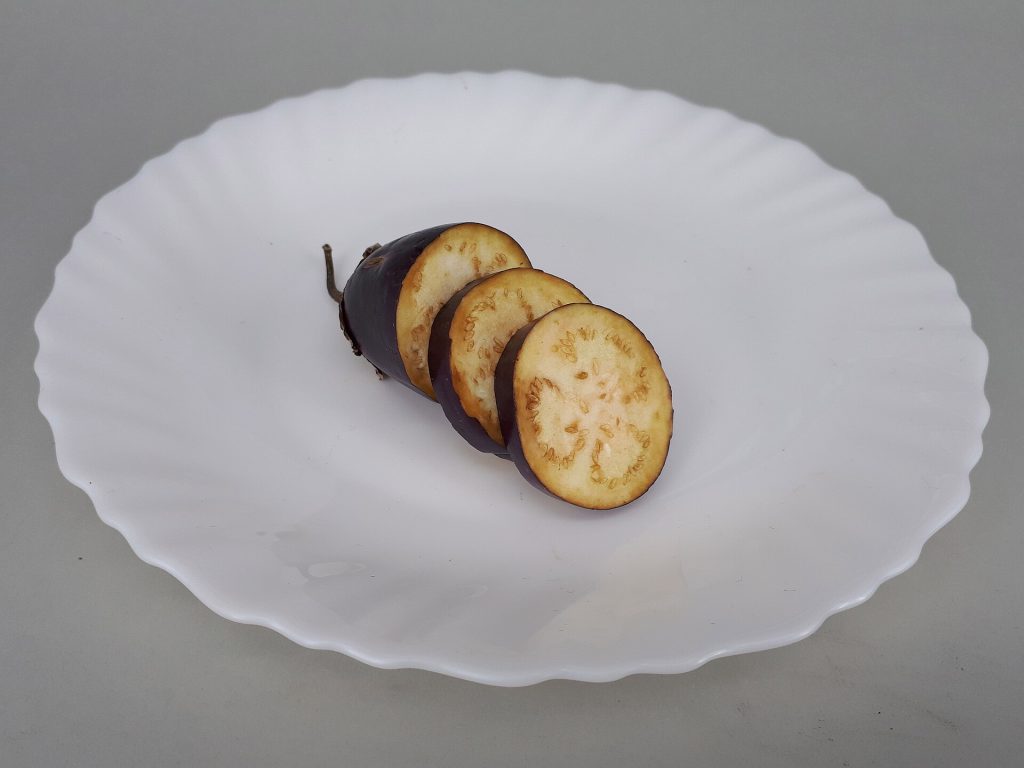
The standard remedy for oily eggplant is to salt the slices, weight them for half an hour, and pat them dry. Salting does something, but it is not the thing that stops the flesh from drinking oil.
Eggplant takes up oil because of its structure, a foam of large cells separated by air spaces. Heat drives the air out, and oil moves in to fill the space it left.
The fix is to collapse that structure before the oil arrives, not to pull water out of the surface beforehand.
Two routes do this well, and both are faster than the salting ritual they replace.
Why the flesh drinks oil
Cut an eggplant and the face looks solid. Under a lens it is a mesh of thin-walled cells with air between them, closer to a sponge than to a potato.
As the flesh heats, the air in those spaces expands and escapes through the cut face. The cells lose their rigidity and the walls press together.
Oil is on the surface at that moment. It flows into the spaces the air has vacated, and the collapsing tissue holds it there.
The result is a slice that weighs more after cooking than before, and a pan that looks dry.
Salting draws water out by osmosis, and that water fills some of the air spaces, which is why salted eggplant absorbs somewhat less oil.
The effect is real but modest, and it costs half an hour. It also leaves a wet surface, and wet eggplant in hot oil spits.
What salt cannot do is stop the collapse. The structure still fails, and the oil still finds the gaps it leaves.
Pre-cooking does stop it, because the collapse happens before any oil is present and the empty spaces close without oil to fill them.
The skin is the one part that does not absorb oil. It is thin, waxy and largely impermeable, which is why small eggplants cooked in their skins stay lighter than peeled slabs.
The dry pan first, then the oil
Put thick slices in a dry pan over medium heat and nothing seems to happen for a minute. Then the surface begins to hiss as water leaves.
Keep going until the cut face is browned in patches and the slice bends without breaking. Three to four minutes a side for a three-quarter-inch plank.
At that point the structure has collapsed. Add oil and it coats the surface instead of disappearing into the flesh.
The slice will take a fraction of the oil it would have taken raw, and it browns better because the surface is already dry.
A nonstick pan makes this easier, but cast iron or well-seasoned steel works and gives more color.
Do not add oil early to stop sticking. If the pan is hot enough and the slice is dry, it releases on its own after two minutes.
Work in batches. Two slices at a time in a ten-inch pan, spaced apart, so the water can escape as steam rather than pool.
The pan will develop a brown film as you go. Wipe it out between batches with a dry cloth, or the next slice will pick up burnt bits.
A dry pan over medium heat is the right setting. Too hot and the outside chars before the inside collapses, which leaves a hard core inside a burnt shell.
Cutting for an even collapse
A whole eggplant cooks unevenly because the neck is thinner than the base. Cut it into pieces of one thickness and the problem goes away.
Three-quarter-inch planks suit a bake or a sandwich. One-inch cubes suit a stew, and wedges suit a grill.
Score the cut face in a shallow diamond pattern, a quarter inch deep. The cuts let steam escape and let the flesh collapse evenly instead of splitting.
Cut on a board with the skin down, so the knife goes through the flesh and stops at the skin. The skin holds the piece together.
Small, firm, glossy eggplants have fewer seeds and less air. The large ones are spongier, and they will absorb more oil no matter how you cook them.
Heavy for its size is a good sign at the shop. A light eggplant of the same size has more air inside, which is more space for oil.
Use the flesh within a day of cutting. Cut eggplant browns at the surface and softens in the fridge, and neither helps the texture.
Peeling is optional and usually a mistake for a bake. The skin holds the piece together and gives the flesh a boundary to collapse against.
If the eggplant is to be stuffed, halve it lengthwise and scoop the flesh after the dry pan, not before. Raw flesh tears and takes the structure with it.
Oil on the surface, not in the bowl
Tossing cubes with oil in a bowl is how most recipes do it, and it is how most of the oil ends up inside the cubes.
Brush the oil on instead, one side at a time, or toss with a single tablespoon and stop when the surface looks glossy rather than wet.
For a tray of cubes, a tablespoon and a half per pound is enough if the pieces are already collapsed or if the oven is hot.
Oil that pools on the tray is oil that did not go into the food. If you see a puddle, you used more than the surface could hold.
Olive oil is fine at 450F for the twenty minutes this takes. Butter is not, because the milk solids burn before the eggplant browns.
Salt after the surfaces have browned. Salt before draws water to the surface and slows the browning that is the whole point.
If the dish needs salt earlier, salt the scored face and blot it after ten minutes, then proceed. That is a compromise, not a requirement.
An oil spray is not the answer. It coats unevenly and the thin patches scorch while the thick ones stay pale.
The oven route at 450F
Heat the tray in the oven, brush the planks with oil, and lay them scored side down on the hot metal. Fifteen minutes, then turn once.
The hot tray does what the dry pan does, on a larger scale, and it dries the surface before the interior collapses.
Do not crowd. One layer with space, and two trays rather than one overloaded one. A crowded tray steams, and steamed eggplant goes back to being a sponge.
Parchment is acceptable here, but bare metal gives a better crust. If you use parchment, preheat it with the tray so it is not cold.
Twenty to twenty-five minutes total for three-quarter-inch planks. The edges should be dark and the center should give when pressed.
For cubes, twenty minutes at 450F on a hot tray, shaken twice, is enough. They should rattle when you shake the tray rather than stick.
Drain finished pieces on a rack, not on paper. Paper traps steam against the bottom and turns the crust soft within a minute.
A squeeze of lemon and a little salt at the end lifts the flavor. Acid also cuts the sensation of fat, which matters with eggplant.
Salt draws water out of the flesh and onto the surface within ten minutes. On a tray in a hot oven that water becomes steam and the planks go grey before they brown.
Turn the planks with a thin spatula, not tongs. Tongs squeeze the flesh and press oil back out of it.
Ten minutes from now
Put a tray in the oven at 450F and a wide dry pan on medium heat at the same time.
Cut an eggplant into three-quarter-inch planks, score the faces, and lay two of them in the dry pan without any oil.
Leave them for three minutes a side, until the face is patched brown and the flesh gives. Then brush both sides with oil and move them to the hot tray.
Repeat with the rest, then give the whole tray twelve minutes in the oven, turning once.
Salt and lemon when they come out, and drain them on a rack for a minute before they go on the plate.
The pan will need only a wipe and the oil bottle will still be almost full, which is the visible sign that the method worked.
Start now. Put an empty tray in at 450F, cut one eggplant into planks, and lay two of them in a dry pan before you reach for the oil.